Research Spotlight: Maral Ganzorig ‘26 Explores How Antibiotics Affect Anxiety
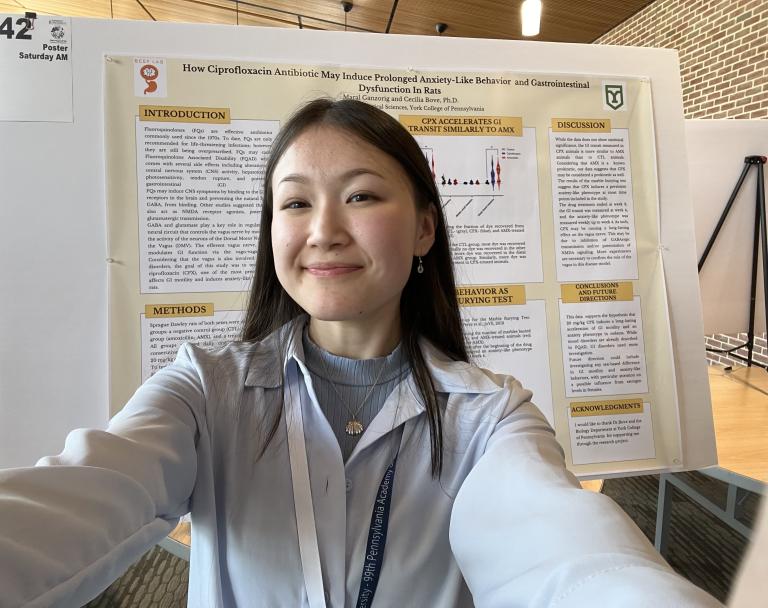
Continuing research she has been involved in since her first year at York College, Maral Ganzorig ‘26 delves into how certain antibiotics can affect the human body and if there are ways to avoid long-lasting side effects.
When Maral Ganzorig ‘26, a Biology major with minors in Neuroscience and Medical Humanities, left her home country of Mongolia to pursue her college education, she found that York College of Pennsylvania offered her a plethora of clubs, organizations, and opportunities for collaboration that allowed her to grow into an individual passionate about science and medicine.
From being a Spartan Ambassador to joining honors societies, becoming President of the PreMed Allied Health Society, to being a member of the Women in Science and Engineering (WISE) Club, Maral has found ample opportunities to grow in experience.
One experience that stands out amongst the others was during her first year of college, when she attended the Clark lecture series, held monthly within the Biology department. There, she met Dr. Cecilia Bove, an Assistant Professor within the Biology Department, and after listening to her presentation, joined her research study on antibiotics. Specifically, focusing on how certain ones can cause long-lasting side effects and if there are ways to treat or avoid them.
Antibiotics and Their Side Effects
For as long as people can remember, antibiotics of varying levels have been used to treat various illnesses.
One of the most commonly prescribed classes of antibiotics is fluoroquinolones. Not only were they lab-made, but they were designed to be incredibly effective and inexpensive to produce, which had increased their popularity since their initial launch in the 1970s.
However, according to a research summary Dr. Bove provided, the antibiotics have been known to carry long-lasting (and sometimes disabling) side effects. The first reports of these severe side effects didn’t prompt a change in policy until 2004, when new guidelines for clinic administration were issued, and research in the field was encouraged to continue.
During her visiting position at Bucknell University, Dr. Bove's scholarly work focused on the long-term side effects of fluoroquinolones. She also shared in her research summary that antibiotics target several brain functions despite not being designed to interact with neurons, affecting their communication abilities. Fluoroquinolones essentially made neurons hyperactive, encouraging them to keep sending rapid messages without any pause between communications.
“My particular interest as a neuroscientist is in understanding how the brain regulates 'background' bodily functions, which are defined as autonomic,” Dr. Bove said. “Specifically, I am interested in the activity of the vagus nerve, which controls our digestive processes (and many other bodily functions that we describe as part of the "rest and digest" system).”
Ultimately, after conducting an experiment of her own, Dr. Bove observed that ciprofloxacin caused accelerated and dysfunctional digestion with the development of anxiety-like behaviors.
Determining Side Effects and Anxiety Behavior
Maral became a part of the research during her first year at York College. She met Dr. Bove while the professor was presenting about her fluoroquinolone research, and connected with her soon after.
Maral helped conduct experiments while Dr. Bove did most of the writing for the publication of the research. It was published in 2025, and credits Maral in it, which she considers to be one of her biggest accomplishments as an undergraduate.
Maral was grateful for Dr. Bove taking the time to teach her everything she needed to know. She loves that the research focuses on providing accessible information for people, especially those who rely on antibiotics and worry about the long-term side effects. Doctors prescribe antibiotics every day, but people either don’t know about the potential side effects they could experience or are too afraid of them to take their needed medication.
Especially when it comes to vulnerable populations such as children and the elderly, being informed about all potential effects that can come from medication is important, especially in protecting their long-term health. It also allowed Maral to begin building her research experience.
Next Steps: The Root of the Cause
Now, Dr. Bove and Maral are working on the next step in delving into the research; understanding what is causing ciprofloxacin to show these debilitating symptoms and if anything can be done to either negate or lessen the side effects.
“Some studies Maral reviewed showed that ciprofloxacin can completely change the composition of the gut flora in human patients,” Dr. Bove said. “The gut flora is crucial for our ability to digest food, combat infections from 'bad' bacteria, and even regulate our mood.”
While most antibiotics cause digestive issues when taken, the body recovers and is back to normal once treatment is completed. However, ciprofloxacin appears to affect the gastrointestinal tract permanently, to the point of causing long-lasting detrimental effects to the individual taking the medicine. Maral wanted to find out if the shift in the gut flora composition was causing the accelerated digestion and anxiety observed initially.
“I’m looking at the microorganisms in the gut,” Maral said, “because there are so many [research] papers about how ciprofloxacin can decrease the amount of microorganisms, and it takes one year to revert back to the original [state].”
Other Research Assistants
Maral isn’t the only one delving into a research topic related to fluoroquinolone. As her research has progressed, Dr. Bove recruited other students not only to assist with her experiments but also to conduct their own research based on the data she has observed and recovered.
For example, Liam Turska ‘26, a Biology major hoping to pursue pre-veterinary studies, joined Dr. Bove’s student team last year after hearing positive feedback from another student about her. He will be focusing on how exposing the gut to ciprofloxacin can influence social recognition and behavior.
Working with other students has also had a positive impact on Maral as she grows in her research capabilities, especially in skills such as teamwork and seeking support with tasks. Having the opportunity not only to learn from those in the grade above her but also to teach those new to the research so they can continue the work after she graduates has been a rewarding experience for her.
“Since I’m graduating this semester, I know there are going to be many more students who’re going to pick up this project and continue it using the previous data, so I think that’s fun to be in something that big - it’s like a chain of effect,” Maral said.
Impact of Learning to Do Research
Being a part of the research has meant a lot to Maral. Back in Mongolia, she didn’t have many opportunities to pursue studies of this level. Now, she is discovering many new opportunities that are allowing her to delve deeper into her passions.

“I have been working with her since the Spring Semester of her first year at YCP, and it's been a pleasure to see her blossom from a hard-working, international student into an independent, high-achieving, and passionate scientist,” Dr. Bove said. “There isn't a single goal Maral set for herself that she did not achieve, and no obstacle is ever too challenging for her. She truly is an inspiration and role model in the community.”
Maral's current goal is to pursue a career in medicine. In the summer of her junior year, she worked as a patient safety at WellSpan Health, an experience that allowed her to take a closer look at the relationship she can have with her patients as an aspiring physician and the care that goes into it. It allowed her to feel a real connection with her patients and feel as though the work she is doing is important.
This semester, she was accepted into a pipeline program where she’ll mentor a few high school students interested in pursuing careers in the medical field. She also volunteers at a nursing home by video calling with a senior every week.
To her, Maral feels as though all of her experiences, especially those related to medicine and helping others, have been helping her to shape her character as a human being.
“I think that York College’s motto, “To Serve is To Live,” that’s my motive for life, to serve is to live,” she said.
Maral is hoping to go into primary care as a physician, citing that she loves being able to interact with patients and hopes to have a closer relationship with them and be closely involved in their care. After shadowing a WellSpan physician, she learned that she can also continue to do independent research and know more about the families she works with.
She cites having the confidence to reach out to Dr. Bove as having impacted her to lead her to where she is now. If she never did, she never would have had the amazing opportunity she has now. The professors are there to support the students, and if a student is ready to pursue their idea, then they can reach out for help and mentorship to make their research a reality.